Digital business cards are becoming a mainstream networking tool for professionals and businesses looking for faster, paperless ways to share contact information.
This article brings together the latest digital business card statistics on market growth, adoption, usage, industry trends, regional demand, and the shift toward NFC and digital-first networking.
- Digital business card market statistics
- Key drivers for digital business card adoption
- Digital business card usage statistics
- Regional market outlook
- Industry-wise usage statistics of digital business cards
- Top players in the digital business card market
- How are NFC-enabled digital business cards the new trend in digital networking?
- What features do people want in digital business cards?
- How do people share digital business cards?
- Why do people use digital business cards?
- The dawn of physical business cards
- The environmental impact of paper business cards
- The future of digital business cards
- Wrapping up
- Frequently asked questions
Digital business card market statistics
The digital business card market is snowballing because of the need for digital and faster networking.
Here are some statistics that summarize the current state of the digital business cards market.
📈 Global digital business card market growth
Reliable market data:
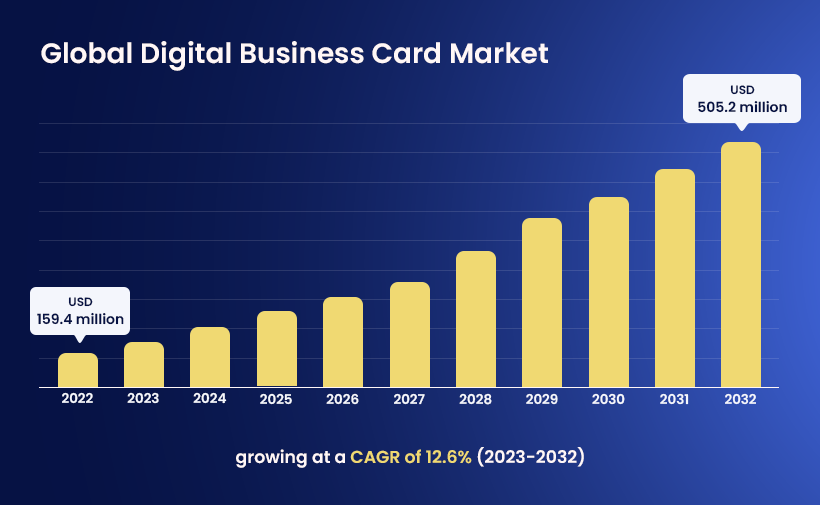
- According to Allied Market Research, the global digital business card market was valued at $159.4 million in 2022 and is projected to reach $505.2 million by 2032, growing at a CAGR of 12.6% from 2023 to 2032.
- Market Research Future estimates the market at $213.50 million in 2025 and $233.74 million in 2026, and projects it to reach $528.12 million by 2035 at a CAGR of 9.48% from 2026 to 2035.
Market estimates vary across research firms because of differences in methodology, market definitions, and forecast periods.
Key drivers for digital business card adoption
Various factors are driving the adoption of digital business cards. According to Maximize Market Research, the following are the key drivers of digital business card adoption:
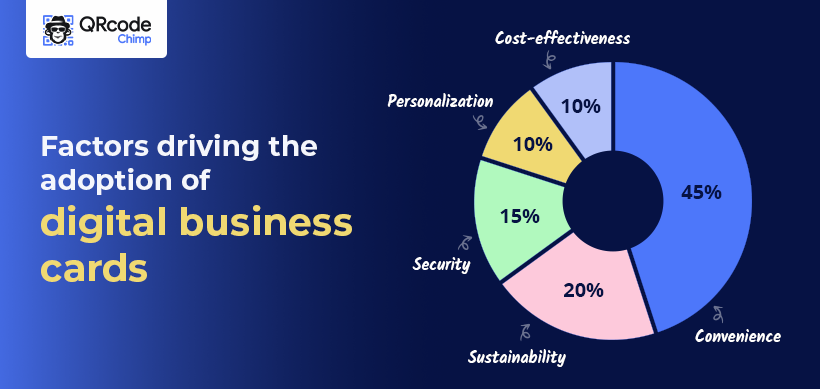
| Factors | Percentage |
|---|---|
| Convenience (ease of contact sharing and saving) | 45% |
| Sustainability | 20% |
| Security | 15% |
| Personalization | 10% |
| Cost-effectiveness | 10% |
Here are some other important factors driving the growth of the global digital business card market.
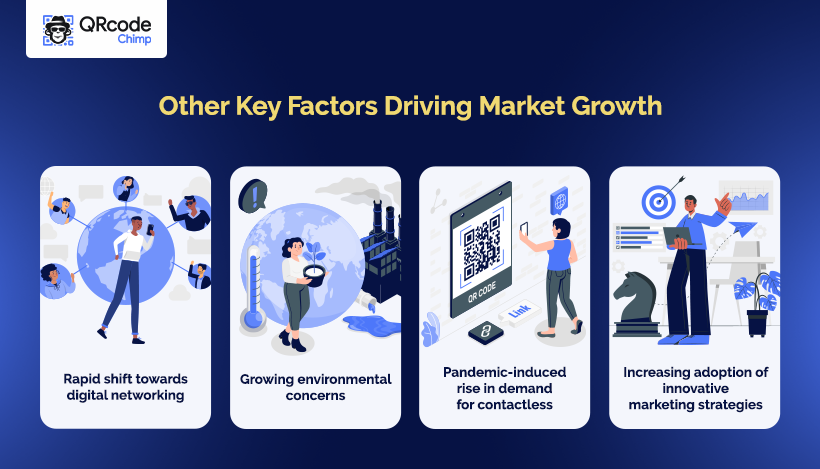
Rapid shift toward digital networking
According to Foundry’s 2023 Digital Business study, 93% of organizations have adopted or have plans to adopt a digital-first business strategy.
With the global business landscape becoming increasingly digital, there has been a rapid shift towards digital networking, resulting in higher demand for digital business cards.
Growing environmental concerns
An estimated 100 billion paper business cards are produced each year globally, while 88% of business cards handed out are discarded within a week.
Business card production consumes natural resources like trees, and discarded cards contribute to paper waste. Switching to digital business cards helps reduce the need for printed cards.
Increasing adoption of innovative marketing strategies
Digital business cards have emerged as an effective marketing tool for boosting brand identity and increasing customer engagement.
Digital business card usage statistics
According to Maximize Market Research, 37% of small businesses and 23% of individuals had used a digital business card app as of 2025.
The ability to seamlessly share and save contact information is a key reason for using digital business cards.
Regional market outlook
According to Fortune Business Insights, the regional distribution of the global digital business card market is:
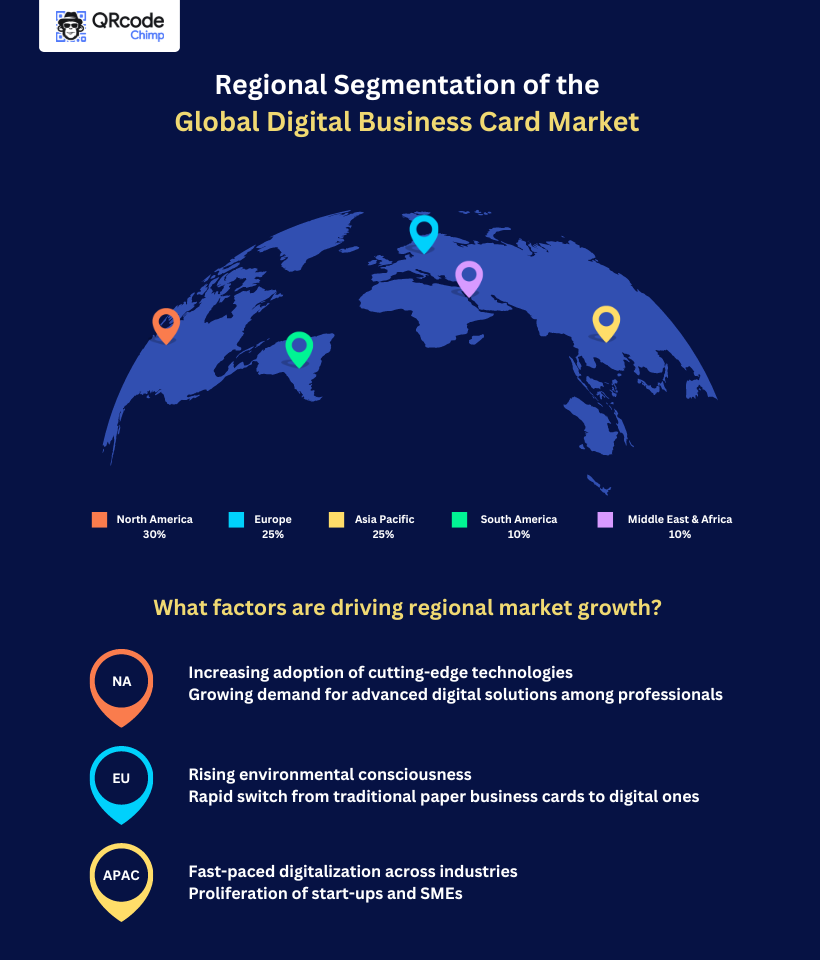
- North America: 30%
- Europe: 25%
- Asia Pacific: 25%
- South America: 10%
- Middle East & Africa: 10%
North America accounts for the largest share, followed by Europe and Asia Pacific.
- North America accounts for around 30% of the global digital business card market.
- Europe accounts for around 25% of the market.
- Asia Pacific also accounts for around 25% of the market.
- Allied Market Research projects the Indian digital business card market to grow at a CAGR of 19.5% from 2023 to 2032.
Industry-wise usage statistics of digital business cards
A revolutionary tool for professionals, digital business cards are increasingly replacing traditional paper business cards. Many industries are adopting this solution not only to double down on their marketing and networking efforts, but also to significantly reduce paper waste and support environmental conservation.
Here are some key statistics on industry usage of digital business cards:
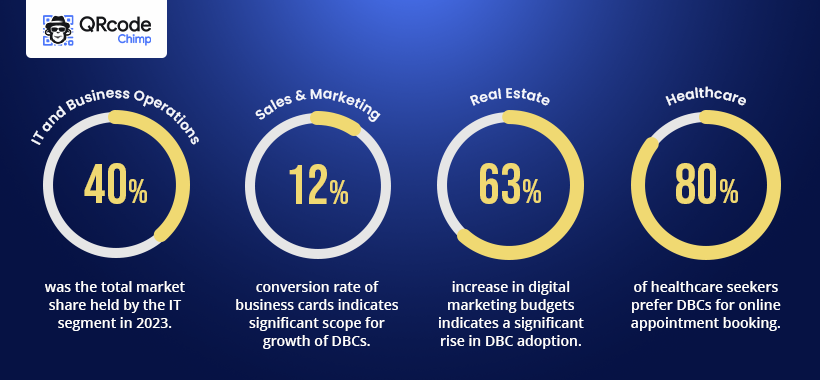
IT and telecommunications
The IT and Telecommunications segment held around 40% of the global digital business card market in 2025.
Growing demand for advanced professional networking tools among IT professionals is a key factor driving the growth of this segment.
Sales & marketing
According to Aura Print, business cards have a 12% conversion rate, which is significantly higher than the 2.35% average website conversion rate.
Around 95% of professionals identify face-to-face meetings as essential for cultivating long-term business relationships.
Business cards play a vital role in driving sales and marketing success. However, this indicates a massive scope of growth for the digital business card market as more industry professionals switch to digital business cards.
Real estate
A 2023 study said that 63% of real estate businesses increased their budgets for digital marketing in the previous year. This budget surge indicates a potential increase in digital business card adoption in this sector.
Healthcare
At least 80% of patients prefer physicians who offer online scheduling. Digital business cards can make scheduling more accessible by linking patients directly to a provider’s appointment-booking service.
Jobs and freelancing
Approximately 85% of jobs are filled through networking, highlighting the importance of professional connections in the job-search process.
Top players in the digital business card market
As the popularity of digital business cards continues to skyrocket, various players have entered the market.
Here are some leading providers of digital business cards globally:
- QRCodeChimp: QRCodeChimp is a digital business card and QR code provider headquartered in Pune, India. Developed by the ex-employees of Google, Yahoo, PayPal, and Bank of America, QRCodeChimp allows you to create professional digital business cards with ease of use and top-notch security.
- HiHello: HiHello is a California-based digital business card provider. It allows you to create custom digital business cards for easy contact sharing.
- L-Card Pro: L-Card is an Indiana-based digital business card solution that allows you to create digital business cards and design physical business cards.
- MobiloCard: Mobilo Card is a digital business card and NFC card provider based in New York, United States.
- Blinq: Blinq is a digital business card app provider based in Australia. It allows you to create, share, and manage your digital business card.
How are NFC-enabled digital business cards the new trend in digital networking?
Amid the fast-paced switch to digital networking solutions, NFC digital business cards have gained much popularity among businesses. Business cards with NFC tags let you instantly share your contact details with a single tap.
According to Verified Market Reports, the global NFC business card market was valued at $40 million in 2026 and is projected to reach $60 million by 2034, growing at a CAGR of 10.5% from 2026 to 2034.
What features do people want in digital business cards?
We surveyed our users on what features they’d like to see in digital business cards. Here are the responses:
- More design and customization options: 17.9%
- Sharing digital business card URL: 17.7%
- Downloadable and printable business card PDF: 14.8%
- Contact forms to collect user data: 14.7%
- Mobile app to create digital business cards: 13.5%
- Secure profile components with password: 12%
- Gamification widgets to engage users: 9.4%
How do people share digital business cards?
We also asked our users about how they share digital business cards. Here are the top responses:
- QR codes on business cards
- Email signature
- Directly share URL
- Social media
- Website
Why do people use digital business cards?
While sharing contact information is the primary application of digital business cards, they also have other uses. We surveyed our users on how they used digital business cards.
Here are the top responses:
- Share contact details
- Lead generation
- Provide business information
- Share product information
- Share team information
The dawn of physical business cards
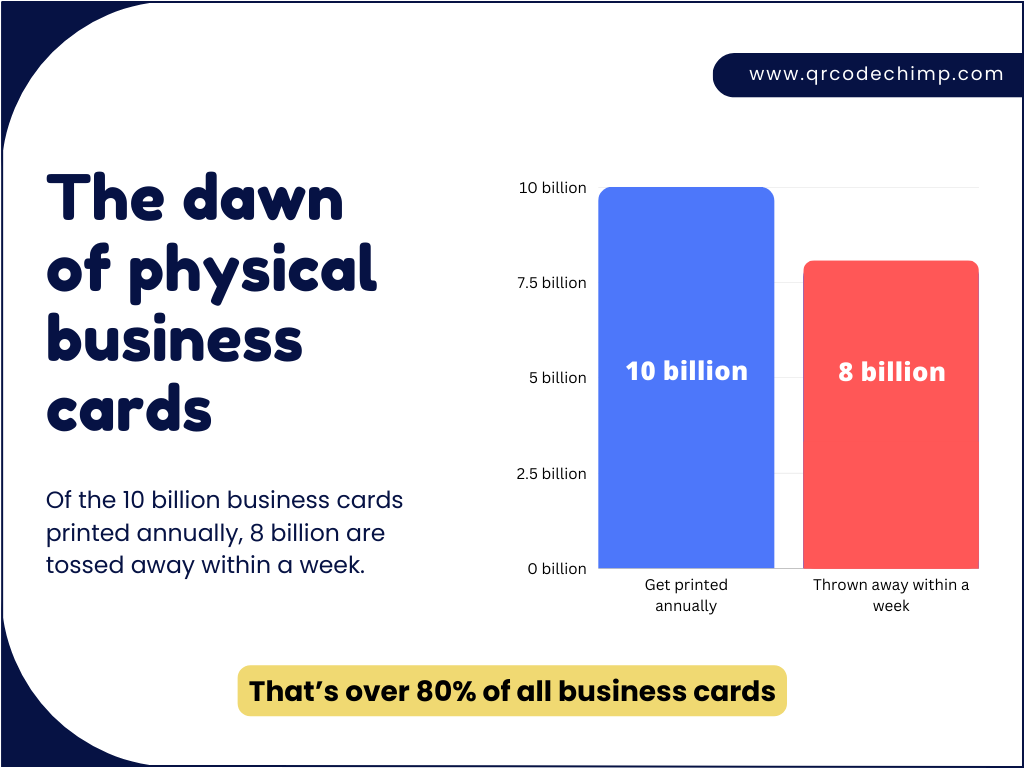
According to Adobe, 88% of business cards handed out are thrown away in less than a week.
The top reasons for throwing away a business card are:
- No need for the product or service
- Lack of value or usefulness
- Poor design and quality
- Too many business cards received
- Lack of personal connection
- Tedious contact-saving process
Even though business cards are effective, they have limitations.
Saving contact information from a physical business card is tedious and time-consuming. Additionally, physical cards are costlier than digital business cards and offer less personalization.
The environmental impact of paper business cards
Earlier, we discussed that sustainability is the second-largest driver of digital business cards. Let’s understand the environmental impact of physical business cards with these statistics:
- Around 100 billion business cards are produced worldwide each year, potentially requiring close to 6 million trees.
- Paper decomposing in landfills contributes to landfill gas, which contains methane. According to the U.S. Environmental Protection Agency, methane is at least 28 times more effective than carbon dioxide at trapping heat in the atmosphere over a 100-year period.
- The U.S. benchmark for water use in pulp and paper mills is approximately 17,000 gallons per ton of paper.
The future of digital business cards
Current market forecasts continue to project strong growth for digital business cards. Allied Market Research projects a 12.6% CAGR from 2023 to 2032, while Market Research Future projects a 9.48% CAGR from 2026 to 2035.
As businesses prioritize smart, paperless networking solutions, companies leveraging customized QR code business cards can use them to support branding, lead generation, client engagement, and data-driven insights.
Wrapping up
Digital business cards have gained much popularity over the last few years. As networking becomes critical to professional and business success, organizations and individuals are increasingly investing in digital business cards.
QRCodeChimp is one of the leading providers of digital business cards. If you’re looking for a secure, feature-rich, and easy-to-use digital business card platform, QRCodeChimp is the ideal pick.
Frequently asked questions
How are digital business cards better than their physical counterparts?
Digital business cards are an eco-friendly, cost-effective, and more efficient alternative to physical business cards. These cards are highly customizable and interactive as compared to the physical cards.
How can I optimize my digital business card?
You can optimize your digital business card by giving it a visually appealing look, adding interactive elements and high-quality graphics, including a strong CTA, and more.
How can I create a digital business card?
You can create a digital business card for free using QRCodeChimp’s Digital Business Card solution.
You may also like
How to Group Cards in QRCodeChimp Entra ID Setup
Learn to organize digital business cards effectively using QRCodeChimp Entra ID grouping. Simplify card management by group, filter, or all-in-one.
First-Party Data Statistics 2026: Adoption, ROI, Privacy, and Collection Trends
Discover the critical aspects of first-party data statistics. Learn how to use them to create personalized marketing campaigns and enhance customer experiences.
Digital Business Cards: A Complete Guide
Learn what a digital business card is, how it works, what to include, and how to share it. See benefits, best practices, and team use cases.
30+ Email Marketing Statistics for 2026: Benchmarks, Deliverability, and ROI
Verified email marketing statistics, including current open rate and click benchmarks, automation performance, deliverability, ROI, AI adoption, and sender requirements.
Most Popular
Contact Sales